Set up the Glossary
With GLC's Glossary feature, you can define how specific terms should be translated, or kept untranslated, across your store. It's perfect for brand names, product terms, and industry-specific words that must stay consistent across all languages.
I. Understanding the Glossary Feature in GLC
The Glossary helps you define and manage key terms, brand vocabulary, and specialized phrases so that they are translated consistently and correctly across all languages in your store.
This is especially useful if your store uses:
- Brand-specific terms (e.g., product lines, collection names)
- Technical terminology
- Marketing taglines or slogans
- Industry-specific words that automatic translation might misinterpret
Example:
- "EcoBlend™" should always stay EcoBlend™
- "All-Natural Fabric" should always be translated as Tissu Naturel Complet (French) or your preferred version
- Glossary rules apply only to new translations generated by OpenAI.
- Existing translations must be re-translated for a rule to take effect.
- Rules apply to in-app translations only. To keep content unchanged in automatic storefront translations, see Exclude selected content from Auto translation.
II. How to Create Translation Rules
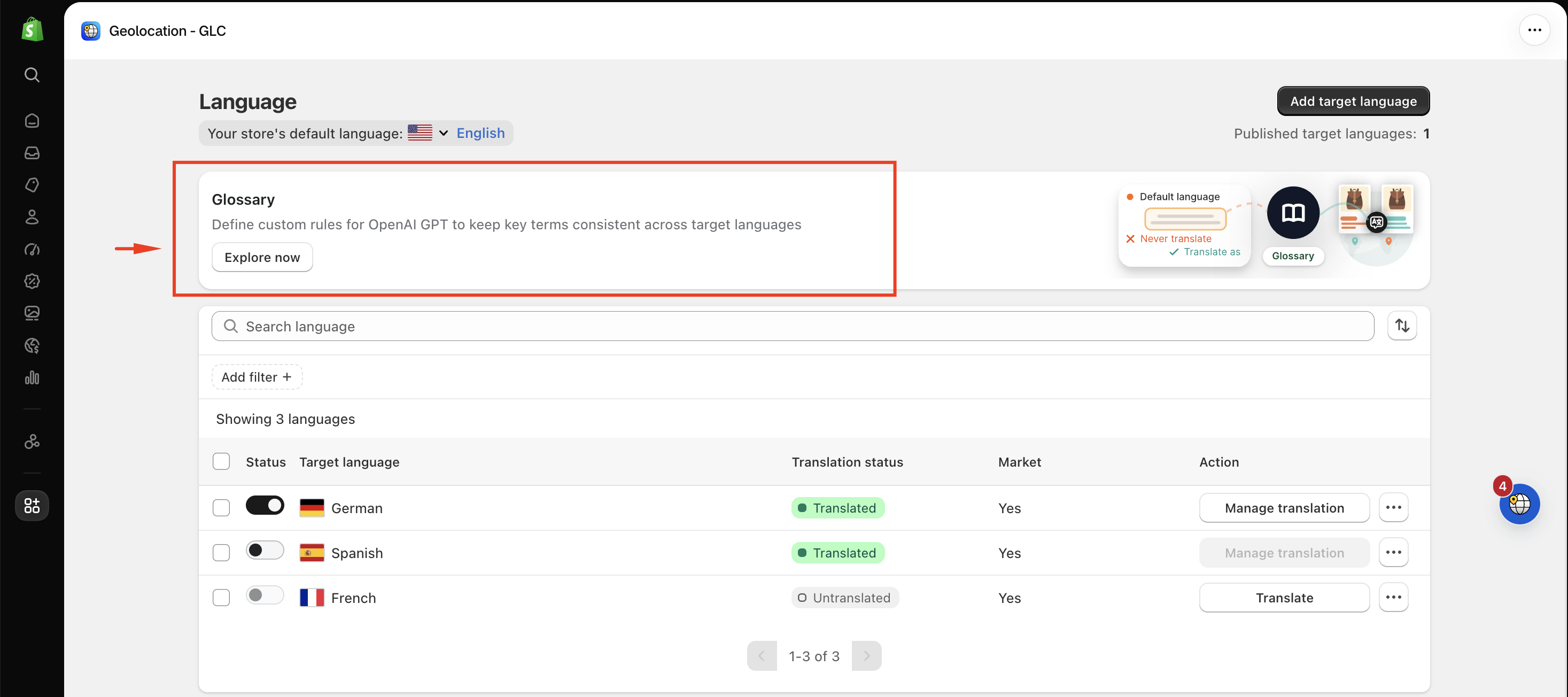
Step 1: Go to Glossary
Go to Language and click Explore now on the Glossary card.
Step 2: Add your rule
Click Add rule to open the rule setup window. GLC supports 2 rule types: Translate as and Never translate.
Translate as
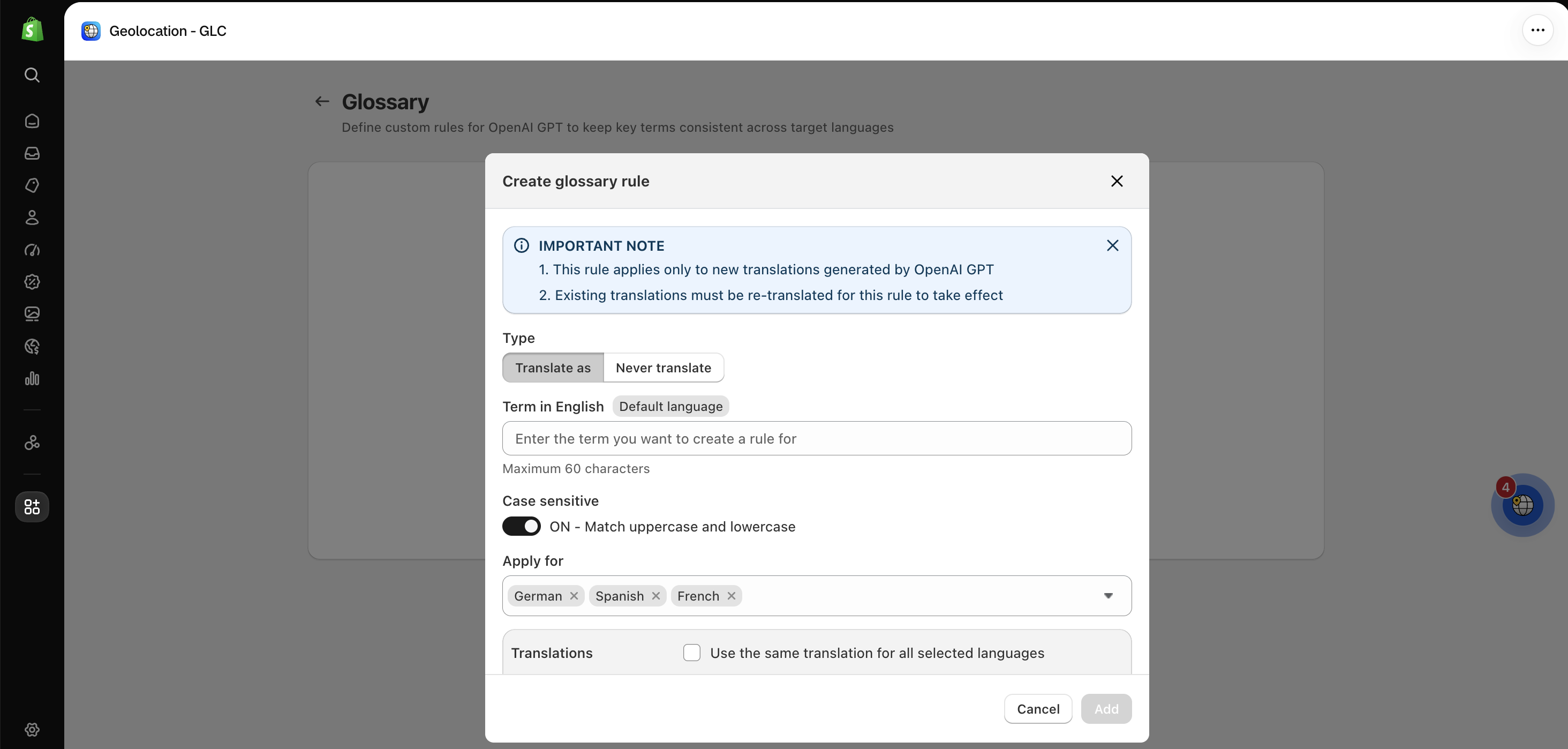
Use this option when you want a term to always be translated in a specific way.
- Term: Enter the word or phrase you want to create a rule for (e.g. your brand name), up to 60 characters.
- Case sensitive: Turn it ON to match the exact letter casing, or OFF to ignore uppercase and lowercase differences.
- Apply for: Select the target languages where this rule should apply.
- Translations: One translation field appears for each selected target language. Enable Use the same translation for all selected languages if you want to apply one translation across all of them.
Never translate
Use this option when you want a term to always stay in its original language and never be translated. Simply enter the term, set Case sensitive, and choose the languages in Apply for.
Step 3: Save the rule
Once done, click Add, then double-check the result on your storefront.
III. Apply Glossary Rules to Existing Translations
After creating or updating a glossary rule, existing translations will not be updated automatically. To apply the new rules to a product, translate it again with AI:
- Go to Language and click Manage translation next to the target language.
- Open Product and find the product you want to update.
- Click Improve translation with AI and choose OpenAI GPT.
- Wait for the translation process to complete, then review and save it.
Improve translation with AI is available only for products. For other content, such as collections or pages, update the translation manually. See Edit translations.
This ensures that your newly created glossary rules are applied consistently across your store. Learn more in Improve translation with AI.
IV. How to Manage Glossary Rules
Once your rules are added, you can easily manage them from the Glossary page:
- Search for a rule, or filter rules by Status, Type, or Case sensitive.
- Enable or disable a rule with its status toggle.
- Click Edit to update a rule.
- Click ⋯ to Pin or Remove a rule, or select several rules and remove them at once.
Notes
- Word limit: Each term can contain up to 60 characters.
- One rule per term: A term can only have one rule in each language. If the term already has a rule in one of the selected languages, GLC shows Rule already exists, so you can edit the existing rule or change the selected languages.
- Exact terms only: Glossary rules apply only to exact terms and do not affect words that contain the term as part of a longer word (for example, a rule for "Home" will not apply to "Homeless").
- Deleted languages: When a target language is deleted, GLC automatically removes that language from your glossary rules. The rules stay in place for your other languages.
If you're not sure which rule to use for a term, or a rule doesn't apply the way you expected, email us at [email protected] with the term and target language. We'll help you set it up.